
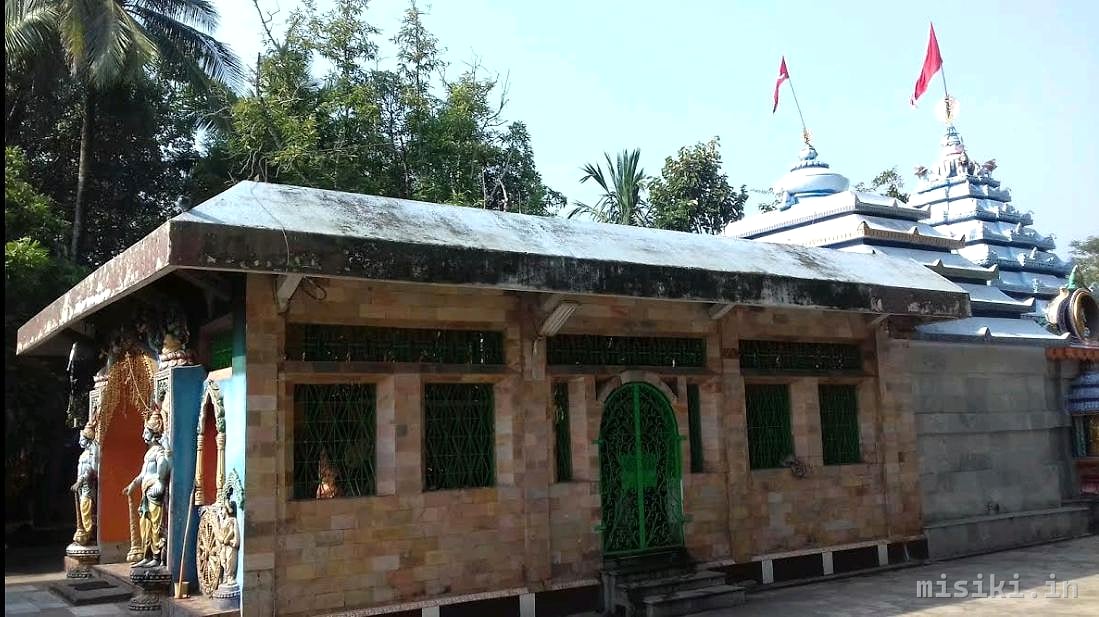
Laxminrusingha Temple Mandira Bhubaneswar Real-Time Guide

11 min read
22 April 2026

The auto stops near Janpath, and you can already smell the thick dhuna mixing with the morning chai from the nearby dukan. That is how you know you are close to the Laxminrusingha Temple. This Narasimha Mandira stands quietly in the Unit 7 area, holding on to its old-world soul while the city rushes past it.

Quick Info
Timings: 6:00 AM to 8:00 PM (Summer), 6:30 AM to 7:30 PM (Winter)
Entry Fee: Free
Best Time to Visit: Early morning before 8:00 AM or during evening Aarti

Kimbadanti and Local Folklore

If you sit with the old pandas of Bhubaneswar, they will tell you that Narasimha is not just a deity you pray to, he is a deity you respect out of a slight, healthy fear. The Laxminrusingha Temple is dedicated to this exact fierce form. The name itself tells a story. It is not just Narasimha. It is Laxmi and Narasimha together. In Odia tradition, we call this form "Laxmi Narasimha". The folklore here is very specific to the local households. Elders in the Unit 7 area say that this temple was built to act as a protector for the entire Janpath settlement. When the city was expanding and new commercial zones were coming up around the Unit areas, people felt the need for a guardian.

The local legend goes deep into the story of Hiranyakashipu and Prahlad. But here, the focus is on the moment right after the killing. The anger of Narasimha is legendary. But in this temple, the idol shows him sitting with Laxmi on his lap. The local belief is that Laxmi is calming him down. She is holding his claws gently. Grandmothers from the nearby sai baba math and residential quarters bring their grandkids here. They point to the idol and say, "Look how angry he looks, but see how gently he holds his wife." This duality is the core of the kimbadanti here. People believe that praying here removes the evil eye. If a business in Janpath is suddenly doing badly, the owner does not go to an astrologer first. They come to Laxminrusingha Temple. They bring a coconut, break it in the courtyard, and leave. The belief is that the fierce energy of Narasimha breaks whatever black magic or bad luck is affecting the business.

There is also a quiet story about the foundation of the temple itself. Unlike the grand ancient temples of Old Town, Laxminrusingha came up more as a community shrine that grew over decades. Some old timers say the original small idol was found buried near a banyan tree when they were digging the foundations for the Unit 7 commercial complex. They could not move the idol to another temple because it was too heavy, or maybe because it chose to stay there itself. So, they built a small tin-roofed structure first. Over the years, as the area got more populated, the temple got a concrete structure. But the core sanctum still has that raw, localized energy of a shrine that grew organically from the soil of Bhubaneswar.

Location and How to Reach

Finding the Laxminrusingha Temple is easy once you know the Janpath layout. But if you are new to Bhubaneswar, the Unit areas can be a bit confusing because the roads are grid-based. The temple is located deep inside the 7. Janpath area, specifically near the New Town side. If you are coming from Master Canteen, take an auto and tell the driver "Unit 7 Laxminrusingha Mandira". It will cost you around thirty to forty rupees. The auto will drop you at the main Janpath road crossing.

Do not expect the temple to be right on the main road. It is not. You have to walk inside. From the main crossing, walk past the row of textile shops and stationary dukans. Take the second left turn. You will see a small yellow board pointing towards the temple. The lane narrows down. You will pass a few old houses with small tulsi chouras in the front. Walk straight for about two minutes. The temple wall will appear on your right. The entrance is a small gate, usually flanked by two cement lions that have been painted over many times. If you are driving your own car, parking is a problem only. There is no dedicated parking lot. You will have to park on the main Janpath road and walk down. If you are coming from the KIIT Square side, take the road towards AG Square and take a right turn into the Unit 7 service road.

Vibe and Atmosphere

The vibe of Laxminrusingha Temple changes completely depending on when you visit. In the early morning, the atmosphere is very raw and grounding. The stone floors are washed with water, and they feel cold under your bare feet. The air is thick with the smell of burning camphor and damp earth. The pandas are just starting their daily rituals. You can hear the loud clanking of the brass bells echoing off the concrete walls. There are very few people at 6:30 AM. Mostly, it is just older men and women doing their parikrama with japamalas in their hands. The sunlight hits the top of the temple dome and filters down slowly. It is extremely quiet, except for the sound of crows and the distant traffic from the main Janpath road.

Come back in the evening, and the scene shifts entirely. The temple courtyard is lit up with yellow tube lights and small diyas. The rush starts around 6:00 PM. Office-goers from the nearby government buildings and private offices drop in on their way home. The noise level goes up. People are talking on their phones, kids are running around the courtyard, and the flower sellers outside the gate are shouting to clear their stock. But despite this chaos, there is a strange order. The priest inside the garbhagriha continues his aarti with his eyes closed, completely unaffected by the crowd. The evening dhuna is very strong. It fills up the entire lane. As the evening progresses, the crowd thins out. By 7:30 PM, the temple goes back to being a quiet, shadowy structure with just the oil lamps glowing in the dark.

Peace of Mind and Spiritual Experience

If you want actual peace of mind here, you have to know where to sit. Do not stand in the main queue. After you take your darshan of Narasimha, walk towards the back of the temple compound. There is a small open area under a big neem tree. There are a few cement benches there. Sit there. You cannot hear the main road from this spot. You can only hear the rustling of the neem leaves and the faint chanting from inside the sanctum. This is the quiet corner of Laxminrusingha Temple. Many locals just come, sit here for fifteen minutes in complete silence, and leave. There is no pressure from pandas to donate or do a special puja. They leave you alone. It is a good spot to just close your eyes and decompress if you are stressed from city traffic. The cool breeze under that tree in the late afternoon is very calming.

Enjoy the Place Type

Different people come here for different reasons. If you are a family visiting on a Sunday, plan your visit around the morning time. Kids will like looking at the small side shrines, and you can easily manage the crowd. For solo travelers and students from nearby coaching centers, this temple is a great spot to just sit and read a book under that neem tree. If you are an architecture enthusiast, you will not find the intricate Kalingan Rekha deul here. The temple is a modern structure built over an older foundation. But if you look closely at the base of the main sanctum, you can see some old stones with faded carvings. They look like fragments of a much older temple that were repurposed when this structure was built. Look at the borders of the main door frame. The wooden carvings there are distinctly Odia, showing scenes of the Dashavatara. They are worth a close look.

Belief and Local Significance

For the locals living in Unit 1 to Unit 9, this temple is their neighborhood guard. The belief is very strong regarding Tuesdays and Saturdays. Tuesdays are for Hanuman, who has a small shrine right outside the main Narasimha sanctum. Saturdays are for Narasimha himself to ward off Shani dosha. You will see a long line of people carrying small mustard oil bottles on Saturdays. They pour the oil on a small metal idol outside and then go in for the main darshan. The local business community around Janpath has a deep faith in this temple. Before opening a new shop, before signing a new rental agreement, or before buying a new vehicle, they bring the keys or the documents, touch them to the feet of the idol, and take it back. It is considered a local blessing for financial stability. The temple also sees a lot of crowds during the Budha Sankranti days, which is a very specific Odia calendar event.

Energy and Vibrations

The energy inside the sanctum of Laxminrusingha is heavy. It is not the soft, peaceful energy you find in a Vishnu or Krishna temple. Because the deity is Narasimha, the energy feels intense and sharp. When you stand in front of the idol, the first thing you notice is the eyes of the deity. Even though it is stone, the way the light hits the sindoor and the kajal applied by the priest, the gaze feels very direct. The priest moves fast. He does not linger. He puts a quick tikka of chandan on your forehead, gives you a flower, and moves to the next person. The vibrations feel very protective, like a shield. You feel a sense of being watched over, but in a strict way. The air inside the garbhagriha is always warm because of the constant oil lamps and the crowd. When the priest does the evening aarti with the big camphor flame, the heat hits your face directly. It is a very grounding, heavy spiritual experience that makes you feel very rooted to the spot.

Comparison Table

Name

Area

Price

Rating

Best For

Laxminrusingha Temple

Unit 7 Janpath

Free

4.2/5

Local blessings and Narasimha puja

Lingaraj Temple

Old Town

Free

4.8/5

Classic Kalinga architecture and history

Ram Mandir

Unit 1 Market

Free

4.5/5

Evening aarti and bustling market vibes

ISKCON Temple

Nayapalli

Free

4.6/5

Clean premises and community meals

Ananta Vasudeva Temple

Old Town

Free

4.4/5

Ancient stone carvings and Vishnu worship

Frequently Asked Questions

Is there a shoe stand outside Laxminrusingha Temple?
There is no official shoe stand with a counter. You just leave your shoes near the main gate on the left side, along with everyone else's. It is safe, but if you have expensive sneakers, it is better to carry a bag and keep them with you inside.

Can I pay for the special puja using UPI?
Yes, the pandas near the sanctum have UPI QR codes printed on small laminated cards. You can scan them using Google Pay or PhonePe. But for a normal darshan, you do not need to pay anything at all.

Is photography allowed inside the temple premises?
You can take photos of the outside structure and the courtyard. But photography is strictly not allowed inside the main sanctum where the Narasimha idol is kept. The pandas will stop you if they see you pointing your phone camera inside.

What are the Abhada or Prasad timings here?
This temple does not have a large-scale kitchen like Lingaraj Temple. The prasad here is mostly dry. You get a small packet of panchamrita, a banana, and some dry khua or sugar drops when you give your offering. It is distributed mostly in the morning after the morning aarti.

Is there parking space for two-wheelers?
You can park your two-wheeler on the narrow lane right outside the temple gate, but only on one side. During evenings, the lane gets very congested. Do not block the lane or the local residents will have an issue. Parking on the main Janpath road is a safer bet.

Can non-Hindus visit this temple?
Yes, there are no strict entry restrictions like in some of the older temples in the Old Town. Anyone can walk in and observe the architecture and the atmosphere from the courtyard. However, only Hindus are allowed inside the main sanctum.

How far is this temple from Bhubaneswar railway station?
It is about 6 kilometers away. An auto will take around twenty to twenty-five minutes depending on the traffic near AG Square and Master Canteen. The fare will be roughly eighty to one hundred rupees.

What should I wear when visiting?
There is no strict dress code enforced by guards, but you are visiting a traditional place. Keep your knees and shoulders covered. Avoid shorts and sleeveless tops. Wearing simple cotton clothes works best in the Bhubaneswar heat.

Is the temple very crowded on weekends?
Saturdays see a good rush because of the Shani puja. Sundays are moderately crowded as families visit after their morning walks in the Janpath area. If you want a completely crowd-free experience, go on a weekday at 7:00 AM.

Are there any good veg restaurants near the temple?
Since it is located in Janpath, you have plenty of options. You can walk to the main road and find small South Indian tiffin centres and Odia thali joints within a two-minute walk. Dalma and rice is easily available nearby.

About this Guide

This guide was curated by the Misiki editorial team. We visit local spots, talk to residents, and verify details to bring you the most authentic recommendations in bhubaneswar.